
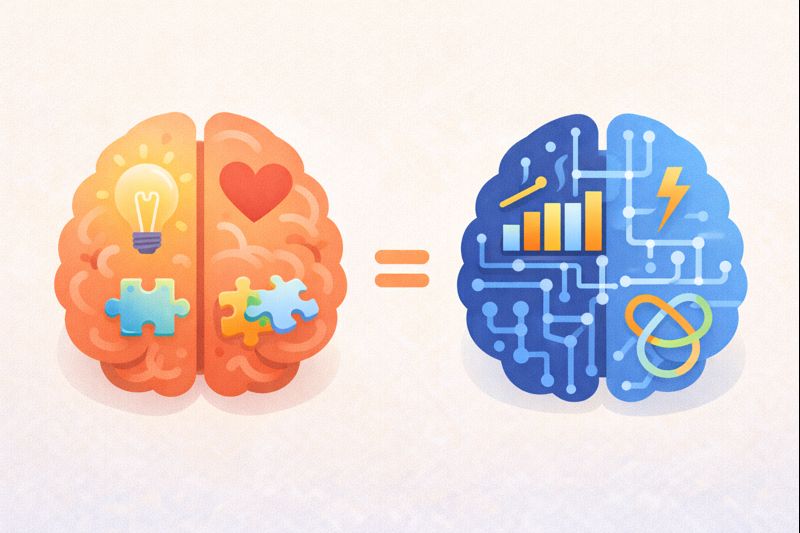
It’s a question you see everywhere, from news headlines to sci-fi movies: is AI smarter than humans? The short, honest answer is: it’s not that simple. Asking if AI is “smarter” is like asking if a library is “more knowledgeable” than a scientist, or if a calculator is “better at math” than a mathematician. They’re just different.
AI, or Artificial Intelligence, is an incredibly powerful tool, but it’s a tool built to do specific jobs in a very specific way. Human intelligence is messy, creative, and deeply connected to our experiences in the world. To really understand the relationship, we need to stop thinking about “smarter vs. dumber” and start thinking about “different tools for different tasks.”
Let’s unpack what we really mean by “intelligence” and see how these two very different systems actually work.
What Do We Even Mean by “Smart”?
Before we can compare, we need to define our terms. When we call a person “smart,” we’re usually talking about a blend of abilities:
- Learning from experience: Figuring out a better way to do something after making a mistake.
- Understanding context: Knowing that the word “bank” means one thing by a river and another thing on a high street.
- Solving new problems: Using creativity and past knowledge to tackle something you’ve never seen before.
- Common sense: Knowing that ice is cold, that you shouldn’t put metal in a microwave, or that if someone is crying, they might be sad.
Human intelligence is general, adaptable, and soaked in our physical and social reality. AI intelligence, at least for now, is something else entirely. It’s much more narrow and specialised.
How AI Thinks: It’s All About Patterns
To understand if AI is smarter than humans, you first have to understand it doesn’t “think” at all in the way we do. Most modern AI, especially the kind that writes text or creates images, is a master of one thing: finding patterns in massive amounts of data.
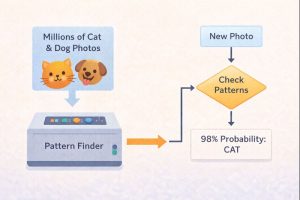
Imagine you showed a friend 10,000 pictures of cats and 10,000 pictures of dogs. Eventually, they’d get pretty good at telling the difference. An AI system does this, but at a scale humans can’t match. It analyzes millions of examples, finds statistical patterns (like the shape of ears, the distance between eyes), and builds a complex model. When you give it a new picture, it doesn’t “see a cat” the way you do—it checks the pixels against its pattern model and calculates the probability that it’s a cat.
Example: An AI that writes essays has read billions of sentences. It learns the statistical likelihood that the word “raining” comes after “It’s” and “cats” comes after “dogs.” It’s brilliant at remixing patterns, but it has no understanding of what rain feels like or what a cat actually is.
This makes AI incredibly powerful for specific, pattern-based tasks, but it also creates its greatest limitations. These limitations become clear when we look at what AI truly excels at.
Where AI Shines
Given how it works, AI isn’t a magic genius. Instead, it’s a phenomenal specialist. Its superpowers are all about scale, speed, and consistency with information.
- Processing Vast Amounts of Data, Instantly: A human analyst might take weeks to spot a trend in a spreadsheet with 100,000 rows. An AI can do it in seconds, across millions of data points. This is why it’s great for weather forecasting or detecting fraud.
- Relentless Repetition Without Tiring: An AI can check the quality of every single widget on a factory line, 24/7, with the same level of attention. A human would get bored, tired, and make mistakes.
- Mixing and Matching Existing Ideas: Tools like image generators are fantastic at combining visual styles (“a cat in the style of Van Gogh”). Language models can quickly draft an email in a certain tone or summarize a long article.
In these narrow lanes, AI’s performance can seem superhuman. But step outside those lanes, and the picture changes completely. This is where human intelligence shows its unique and irreplaceable value.
The Unbeatable Strengths of Human Intelligence
While AI is a pattern-matching powerhouse, human intelligence is built on a foundation that AI currently lacks. Our smarts come from living in a physical world and interacting with other people.
- Common Sense and Physical Intuition: You know that a coffee cup won’t hover in mid-air if you let go. You understand that if someone says “I’m so hot,” they might want a fan, not a compliment. AI has no innate understanding of basic physics or social norms unless it’s been explicitly trained on that exact scenario—and even then, it doesn’t truly understand.
- Creativity and True Innovation: AI can remix what it’s seen before. But the leap of imagination that led to the theory of relativity, the invention of the wheel, or the composition of a totally new genre of music? That’s human. It comes from curiosity, emotion, and making unexpected connections.
- Emotional and Ethical Understanding: A doctor can deliver a difficult diagnosis with empathy. A teacher can sense a student’s frustration and adjust their approach. AI can mimic empathetic language, but it doesn’t feel care or responsibility. Making complex ethical decisions requires a human context that AI simply doesn’t possess.
This isn’t about one being “better”; it’s about them being complementary. One is a brilliant, fast, but literal-minded specialist. The other is a slower, adaptable, and deeply contextual generalist. This fundamental difference is why the idea of a single “smarter” label doesn’t fit.
The “Different, Not Smarter” Mindset
So, is AI smarter than humans? The most helpful way to see it is as a partnership of different strengths. Think of it like this:
- Human + AI: A doctor (human intuition, empathy, diagnosis) uses an AI tool to analyze thousands of medical scans (pattern recognition) to spot early signs of disease they might have missed.
- AI + Human: An AI drafts a first version of a report in seconds (data compilation, structure), and a human editor refines it, adds critical insight, and ensures it makes sense for the audience (context, creativity, nuance).
The risk comes when we expect one to do the job of the other—like asking an AI for life advice or expecting a human to memorize an entire library instantly. The most powerful applications happen when we play to each system’s strengths. Of course, using any powerful tool responsibly means understanding its limits, especially when it comes to getting things wrong.
When AI Gets It Wrong: Hallucinations and Bias
Because AI works on patterns and probabilities, it can fail in ways that seem bizarre to a human. These failures highlight that it’s not reasoning, just calculating.
- “Hallucinations”: This is the term for when a confident AI just makes stuff up. It might cite a scientific paper that doesn’t exist or create a biography for a historical figure with perfect, convincing detail—all fabricated. It’s not lying; it’s generating a statistically probable answer that isn’t grounded in fact.
- Amplifying Bias: An AI trained on data from the internet will also learn the biases present in that data. As a major 2023 report from Stanford University’s Institute for Human-Centered AI (HAI) detailed in their AI Index, models can perpetuate and even amplify societal stereotypes around gender, race, and culture because they reflect the patterns in their training data, without the human ability to critique or correct for fairness.
Understanding these flaws is crucial. It reminds us that AI is a tool to assist and augment, not an infallible oracle to replace human judgment. With this balanced view, let’s tackle some of the most common questions people have.
How AI Can Improve Productivity
Frequently Asked Questions
Q1: Will AI eventually become smarter than humans in everything?
A: This is a concept called Artificial General Intelligence (AGI). Most experts agree we are very, very far from this, if it’s even possible. Current AI excels at specific tasks but lacks the general understanding, consciousness, and adaptability of a human mind.
Q2: Can AI be creative?
A: AI can be generative—it can produce new combinations of art, music, or text based on what it’s learned. But this is different from human creativity, which is driven by personal experience, emotion, and intent. AI is a new kind of tool for creative people to use.
Q3: Should I be worried about AI taking my job?
A: History shows that new tools change jobs more than they simply erase them. AI is likely to automate certain repetitive tasks within jobs. The key is to focus on building skills that leverage human strengths: critical thinking, creativity, empathy, and complex problem-solving.
Q4: Does AI learn on its own?
A: Not in the way a human does. An AI model is trained on a huge dataset by its developers. Once released, most models don’t continuously learn from user interactions in real-time (though they may be updated periodically). They apply what they learned in training.
Q5: How can I use AI responsibly?
A: Use it as a starting point or a helper, not a final authority. Always fact-check its outputs, especially for important information. Be aware of its tendency to “hallucinate” and remember that it lacks true understanding or ethics.
Conclusion
The debate about whether AI is smarter than humans misses the point. Intelligence isn’t a single ladder with humans on one rung and AI on another. It’s more like a diverse ecosystem.
AI brings unprecedented speed, scale, and analytical power to tasks defined by data and patterns. Humans bring context, ethics, creativity, and a deep understanding of the physical and social world. One isn’t universally smarter; they are profoundly different.
The most exciting future isn’t one where machines replace us, but one where they empower us. By understanding what AI is truly good at, and where it fundamentally differs from us, we can use it as a tool to amplify our own uniquely human abilities, tackle bigger challenges, and maybe even understand our own intelligence a little better along the way.
AI in Education: Learning Without Losing the Ability to Think

Leave feedback about this