
Imagine you’re starting a new semester. You need to register for classes, apply for a library card, sign into the campus tutoring portal, and submit proof of your student status for a bus pass. That’s four different usernames to create, four passwords to remember, and four websites to navigate. It’s enough to make anyone’s head spin before classes even begin.
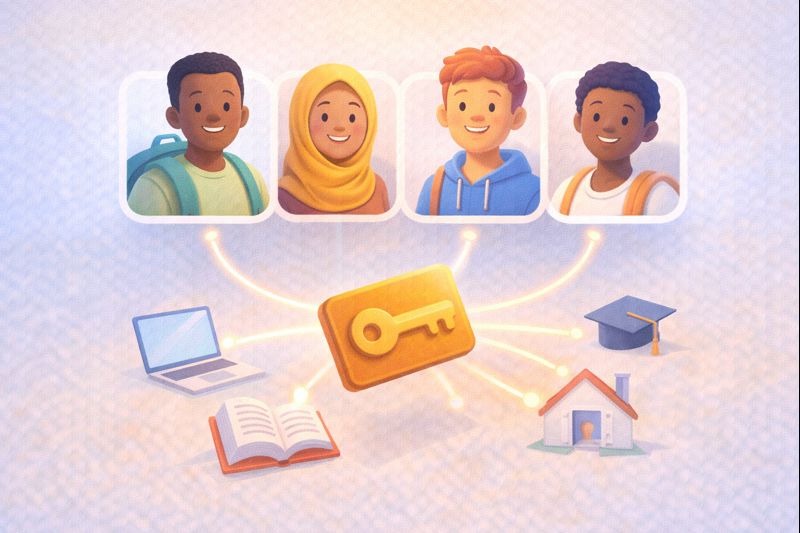
Now, picture a simpler way. What if you had one single, secured digital identity that could smoothly unlock all those doors for you? This isn’t science fiction; it’s a practical shift happening in education right now. A digital identity is essentially your official online profile. It can be verified by your school or a trusted organization, that proves “you are you” across different digital services.
It’s not about creating an online persona; it’s about simplifying the very real, often frustrating, administrative side of being a student. Let’s explore how this one key can start to untangle the web of logins and forms that can make accessing education feel more complicated than it needs to be.
What Exactly Is a “Digital Identity” for a Student?
Let’s break down the jargon. Think of your digital identity in education like your student ID card, but for the online world.
Your plastic student ID proves who you are on campus to get into the gym or check out a book. Your digital student ID does the same thing for websites and apps. It’s a collection of verified information—like your name, your student ID number, and your enrollment status—that online systems can recognize and trust.
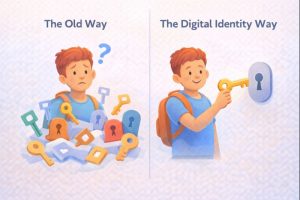
- The Old Way: Every new portal asks you to “Create an Account.” You fill out the same details over and over: name, date of birth, student email. You have a password for the learning portal, a different one for your grades, and another for the career center. It’s fragmented and repetitive.
- The Digital Identity Way: You have one central login, often managed by your school. When you go to the career center’s website, you click “Sign in with your University Account.” It recognizes you instantly, knows you’re a currently enrolled junior, and lets you in—no new account needed.
This shift from many keys to one master key is the first, most basic way digital identity cuts through clutter. And the first place you’ll likely feel that benefit is right at the starting line: signing up for everything.

Your One Login for Everything: Starting School Smoothly
The beginning of any educational journey is often a paperwork marathon. A strong digital identity system can turn that marathon into a quick jog.
Example: Maria is starting at a community college. Instead of receiving a dozen different emails with separate login instructions for email, the course platform, the library, and the health portal, she gets one welcome email. It directs her to activate her central digital identity. Once she does:
- Her school email is already set up.
- She’s automatically enrolled in the orientation course on the learning platform.
- Her library account is created and ready to go.
- She can instantly access the student health portal to submit her forms.
The tedious process of proving “I am a new student here” to every single department happens just once, behind the scenes. This doesn’t just save time; it reduces the “digital friction” that can make starting school feel overwhelming, especially for students who might be less familiar with navigating complex online systems. Once you’re in, this unified identity opens up a world of tailored resources.
Accessing the Right Help at the Right Time
A campus is full of resources, but finding the ones you’re eligible for can be a scavenger hunt. A smart digital identity can act as a helpful guide.
Because your digital profile knows you’re a student (and potentially your year, major, or course enrollment), it can personalize your access. This means you see the tools and opportunities that are relevant to you.
- Personalized Portals: When you log into the main student hub, you might see a alert that says, “Students in BIOL 101: Your lab software access is here,” with a direct link. Or, “Based on your major, check out this internship webinar.”
- Streamlined Applications: Need a scholarship, a work-study position, or access to a specialized software license? Instead of hunting down a form and then attaching copies of your enrollment proof, you could click “Apply.” Your digital identity would securely share the necessary verification (like your active student status) with the application automatically, with your permission.
This targeted access ensures students don’t miss out on support because they didn’t know where to look or got lost in a generic website. It brings the help to you. And in today’s world, this access shouldn’t stop at the campus border.
Learning from Anywhere: The Remote Access Benefit
The need to learn from anywhere is more important than ever. A robust digital identity is the foundation that makes secure, remote learning possible.
Think about the online library. To read that crucial academic journal from your kitchen table, you need to prove you’re a student. With a digital identity, you simply log in. The library’s system trusts your school’s verification and grants you access. This same principle applies to tutoring sessions, academic advising, club meetings, and submitting assignments.
It creates a seamless “campus” experience that exists wherever you have an internet connection, ensuring that geography or circumstance doesn’t become a barrier to using essential educational services. Of course, putting so much importance on one digital key brings up a very valid and important concern: is it safe?
Privacy and Security: Your Data, Your Control
This is the most critical part. A good digital identity system isn’t about collecting more data; it’s about giving you more control over your data and protecting it better.
The old way—having your personal data stored in a dozen different campus databases actually increases risk. If one small, less-secure department site has a breach, your information could be exposed. A 2021 report by Verizon in their Data Breach Investigations Report (DBIR) consistently finds that the education sector faces significant threats from basic human error and system intrusions, often exacerbated by fragmented systems.
A well-designed, centralized digital identity system, built with modern security and privacy principles, can actually reduce this risk. Here’s how:
- Single Source of Security: IT experts can focus on protecting one robust system instead of many weaker ones.
- Your Permission is Key: It should operate on a principle of “consent.” When a service needs to know you’re a student, it asks you for permission to confirm that one fact with your identity provider. You aren’t handing over your full profile.
- Clearer Transparency: You can often see a log of what services you’ve accessed with your digital identity, giving you more visibility into your digital footprint.
The goal is to put you in the driver’s seat, making access easier while building walls around your data that are higher and stronger. With this understanding of the “what” and the “how,” let’s address some common questions you might have.
Frequently Asked Questions
1. Does digital identity track everything I do?
No. It verifies access, not behavior.
2. What if I forget my login details?
Recovery options and IT support are usually available.
3. Can it be used outside school?
In some cases, yes, such as student discounts or services.
4. Is digital identity mandatory?
That depends on the institution, but privacy settings should be clear.
5. Is it safer than social media logins?
Yes. It is governed by stricter educational data policies.
Conclusion
The path through education is challenging enough intellectually without unnecessary administrative roadblocks. A student’s digital identity, when designed thoughtfully, isn’t a tool for surveillance; it’s a tool for empowerment.
It simplifies the logistics of being a student—from enrollment to accessing specialized resources—so you can focus more mental energy on actually learning. It builds a bridge for remote access and creates the potential for a more personalized support system. And when built with strong privacy principles, it can offer better protection for your personal information than the scattered logins of the past.
As education continues to evolve digitally, this concept of a secure, student-controlled key is less about fancy technology and more about a simple promise: making the incredible resources of education genuinely easier for every student to access and use.