
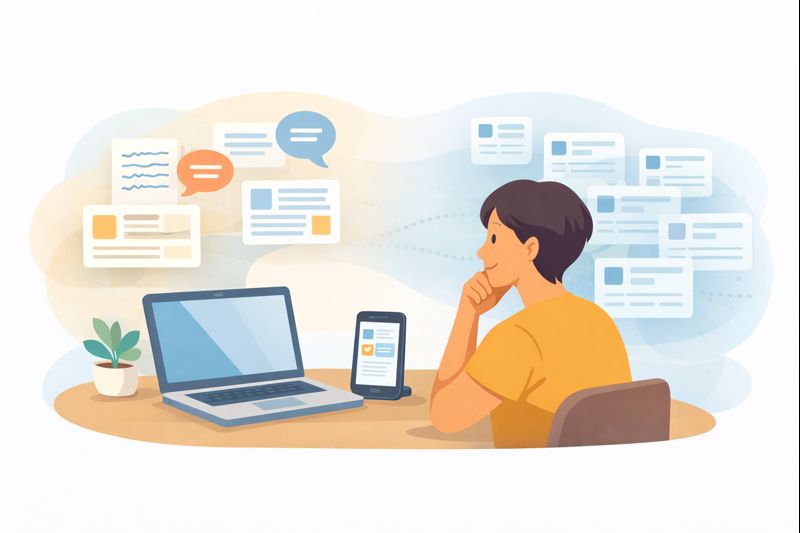
Have you ever opened a website or scrolled through social media and thought, “This sounds familiar” or “Why does everything feel the same?” You might notice articles that repeat similar phrases, social media posts that look oddly generic, or comment sections filled with short, predictable replies. These moments often make people wonder whether real humans are still behind most online content.
This growing feeling has given rise to something called the “Dead Internet Theory.” Despite its dramatic name, the idea is not about the internet disappearing. Instead, it raises a simpler question: What if a large portion of online content is no longer created by humans, but by automated systems and artificial intelligence?
In this article, we’ll explore what the “Dead Internet Theory” actually means, why AI-generated content is becoming more common, and what this shift means for everyday users. To understand it clearly, we first need to look at what the theory really claims and what it does not claim.
What Is the “Dead Internet Theory,” Really?
The “Dead Internet Theory” is not a scientific law or an official claim. It’s a way people describe the feeling that much of the internet seems automated, repetitive, or less personal than it once was.
At its core, the theory suggests three main ideas:
- A growing amount of online content is generated automatically
- Bots and AI systems now create posts, comments, and articles at scale
- Human-created content is becoming harder to spot
Importantly, this theory does not mean:
- The internet is literally dead
- Humans have stopped creating content
- AI controls everything online
Instead, it reflects a noticeable change in how content is produced and distributed. Understanding why this change is happening helps remove fear and confusion, so let’s look at what’s driving it.
Why AI-Generated Content Is Increasing Online
AI-generated content didn’t appear overnight. Several practical reasons explain why it’s becoming more common.
Speed and scale
AI can generate large amounts of text quickly. Businesses, websites, and platforms often need:
- Product description
- Blog posts
- Customer responses
- Social media captions
Using AI allows them to produce this content faster than human-only teams could.
Cost and efficiency
Hiring writers, moderators, and support staff costs time and money. AI tools reduce that cost, especially for repetitive or simple tasks. This makes automation attractive, even when human quality is still better.
Platform demand
Online platforms reward frequent posting. The more content that appears, the more chances users have to stay engaged. AI helps meet that demand, even if the content is less personal.
These reasons don’t require bad intentions. They reflect practical choices made at scale. However, they do change how online spaces feel, which brings us to the next point.
Where AI-Generated Content Shows Up Most Often
AI content is not evenly spread across the internet. It appears more frequently in certain areas.
Websites and blogs
- Many websites now use AI to:
- Rewrite existing articles
- Generate summaries
- Create SEO-focused content
Some of this content is helpful. Some feels repetitive because it follows similar patterns.
Social media
On social platforms, AI often appears as:
- Automated replies
- Generic comments
- Reposted or slightly reworded content
These posts may look human at first glance but lack personal detail or unique perspective.
Comment sections and forums
Bots are commonly used to:
- Increase engagement numbers
- Promote products or links
- Fill discussions with activity
This can make conversations feel shallow or repetitive.
Recognizing where AI content appears helps explain why many users sense a change in online interaction. Still, not all automation is harmful, which is an important distinction to make.
How AI Can Improve Productivity


AI Content Is Not Automatically a Problem
It’s easy to assume AI-generated content is bad, but that’s not always true. AI can be useful when it:
- Summarizes long information
- Helps translate languages
- Provides quick answers
- Supports accessibility tools
The issue arises when AI content replaces thoughtful human cmunication or floods spaces designed for genuine interaction. The challenge is not AI itself, but how and where it’s used.
This explains why the internet can feel less personal at times. To understand this better, let’s explore why AI content often feels repetitive.
Why AI Content Often Sounds the Same
AI systems learn patterns from existing data. When many tools are trained on similar sources, their outputs naturally resemble one another. This leads to:
- Repeated phrases
- Similar sentence structures
- Safe, neutral wording
For example, many AI-written articles begin with broad statements, avoid strong opinions, and summarize common points. While this makes content readable, it can also make it feel bland. Humans, on the other hand, bring:
- Personal experiences
- Emotional nuance
- Unexpected insights
That contrast is why human writing still stands out when it’s present. Knowing this difference helps users read more critically.
Are Humans Being Replaced Online?
No. Humans are still deeply involved in creating, guiding, and consuming content online. What is changing is the ratio between human-written content and AI-generated contents.
- More automated content exists
- Human-created content competes with higher volume
- Attention becomes harder to earn
Instead of replacing humans, AI often works alongside them. Many creators use AI as a starting point, then edit and personalize the result.
What the “Dead Internet Theory” Gets Right and Wrong
The theory gets one thing right: automation is increasing, and it changes how online spaces feel. However, it goes too far when it suggests:
- Humans are disappearing
- Authentic content no longer exists
- Everything online is fake
The reality sits in between. The internet is evolving, not dying. Understanding that evolution allows users to participate more intentionally.
Common AI mistakes beginners make and how to avoid them
Frequently Asked Questions
Q: Is most online content really made by AI?
A: No. While AI-generated content is growing, humans still create a large portion of meaningful online material.
Q: Can AI-generated content be useful?
A: Yes. AI is helpful for summaries, accessibility, and routine tasks.
Q: Why does AI content feel repetitive?
A: Because AI learns patterns from existing data and often produces safe, generalized responses.
Q: Will AI replace human creativity online?
A: Unlikely. Human creativity remains valuable, especially where personal insight and emotion matter.
Q: How can I tell if content is human-written?
A: Look for personal experience, unique perspective, and natural variation in tone and structure.
An Internet That’s Changing, Not Ending
The “Dead Internet Theory” reflects a real shift in how content is created, but it doesn’t mean the internet has lost its humanity. AI-generated content is becoming more common because it’s fast, efficient, and scalable—not because humans are no longer needed.
Understanding this helps remove fear and confusion. It allows users to read more critically, choose content more carefully, and value authentic voices when they find them. The internet is not dead, it’s evolving.
In the next guide, we’ll explore how this rise in automation connects to misinformation and how users can stay informed in a world of rapidly generated content.